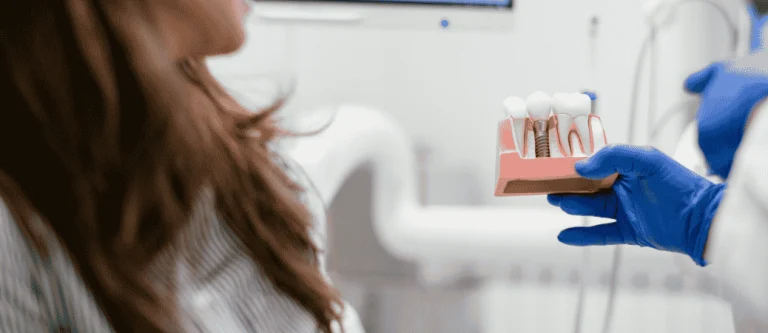


If you’ve been told you don’t have enough bone for dental implants, or you’re tired of dentures that slip when you laugh, you may wonder whether fixed teeth are possible.
Understanding All-on-4 vs. All-on-X implants can help you compare the number of implants used, bone requirements, and treatment options before your consultation.
Both treatments can replace a full arch of missing teeth. All-on-X dental implants offer a personalized approach to restoring a secure, functional smile, with the number and placement of implants determined by your individual needs.
A clinical exam and 3D scan help determine which approach may work best for you.
At Old North Dentures and Implants, the first conversation is usually about ruling things in, not ruling you out.
Many patients come in assuming bone loss or a medical condition is an automatic disqualifier, when it often just changes the plan.
Key Takeaways
- Candidacy depends mainly on your bone, gum health, and medical history, not your age or how many years you’ve worn dentures.
- A CBCT scan helps evaluate available bone and important anatomical structures in three dimensions. Some patients with bone loss may still qualify for implants, depending on their jaw anatomy and treatment needs.
- Four implants work for many patients, but some need five, six, or specialized implant positions for a stable, long-lasting bridge.
Who May Qualify for a Fixed Full-Arch Restoration?
Most people missing most or all of their teeth in an upper or lower arch, or wearing a loose denture they’re unhappy with, can be considered for a full-arch restoration.
The decision comes down to the condition of your remaining teeth, the health of your gums and bone, and whether you want a bridge that stays fixed in your mouth permanently.
Can You Qualify If You Still Have Some Teeth?
Having a few remaining teeth doesn’t rule you out, but it does change the conversation.
If your dentist can save healthy teeth, they usually will, since All-on-4 is more often recommended when most teeth in an arch are already missing or too damaged to keep.
When remaining teeth are failing from decay or advanced gum disease, extractions can sometimes happen the same day as implant placement.
Can Denture Wearers Switch to Fixed Teeth?
Yes, switching from removable dentures to a fixed bridge is one of the most common reasons patients seek this treatment.
Traditional dentures rest on your gums and can shift while eating or speaking, while a full-arch implant bridge is anchored to implants and doesn’t come out at night.
Years of denture wear can shrink your jawbone, but that shrinkage is evaluated, not treated as an automatic barrier.
What Must Be in Place for Implants to Work?
Implants need healthy gums, stable overall health, and enough usable bone to anchor securely, which your dental team confirms through imaging. Active infection or untreated gum disease typically needs attention first.
Your dentist also reviews your medical history, medications, and overall surgical risks before recommending treatment.
When appropriate, sedation dentistry can help patients feel more comfortable during implant procedures.
How Does Your Jawbone Affect Eligibility?
Your jawbone’s density and shape largely determine where implants can go and how many you’ll need, which is why imaging comes before any treatment decision.
Jaw anatomy varies a lot from person to person, and years of missing teeth can lead to bone resorption that shows up differently depending on which part of the jaw lost density first.
What Can a CBCT Scan Reveal?
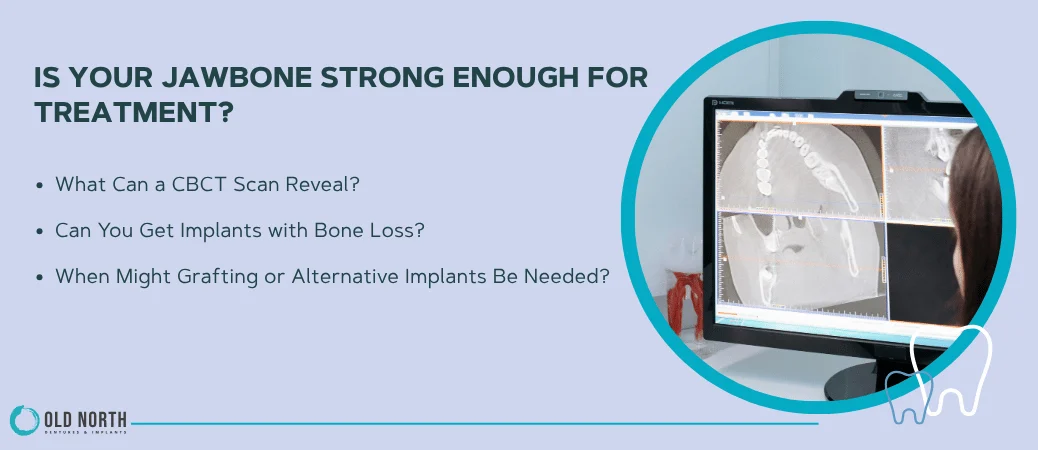
A CBCT scan gives your dental team a 3D view of your jaw, helping them assess available bone, its dimensions, sinus position, and nerve pathways. This information supports more precise planning for implant placement.
This type of imaging can reveal usable bone in areas that a flat two-dimensional X-ray simply can’t show, which is often why patients get a more hopeful answer than they expected.
Can You Get Implants with Bone Loss?
Many patients with moderate bone loss still qualify, because the All-on-4 design places the back two implants at an angle to reach the densest bone still available.
This angled, tilted posterior implant placement was part of the original design rationale when the technique was introduced in the late 1990s as a graftless option for people with limited bone.
That angling often avoids the exact spots where bone has thinned the most.
When Might Grafting or Alternative Implants Be Needed?
Bone grafting or a sinus lift can rebuild bone in cases where there simply isn’t enough left to anchor a standard implant safely.
For more severe bone loss, especially in the upper jaw, your surgeon might consider zygomatic implants, which anchor into the cheekbone, or pterygoid implants, which engage bone farther back in the skull.
These options exist specifically for patients who were previously considered poor candidates for grafting.
Which Health Factors Could Change Your Treatment Plan?
Your medical history affects how your implants heal and how long they’re likely to last, but very few conditions rule out treatment outright.
What matters most is whether a condition is managed and stable at the time of surgery.
How Do Smoking and Medical Conditions Affect Healing?
Smoking reduces blood flow to your gums and can interfere with osseointegration, the process where bone fuses to the implant surface.
This doesn’t automatically disqualify you, but your surgeon will likely ask you to cut back or stop before surgery and through healing.
Conditions like uncontrolled diabetes or heart disease can also complicate healing, so your dental team may coordinate care with your physician beforehand.
What If You Have Gum Disease or Take Bone-Related Medication?
Active gum disease needs treatment before implant surgery, since untreated infection can undermine healing and lead to implant failure down the line.
If your remaining teeth are failing from gum disease, they’re often removed at the same visit as implant placement, which removes much of the infection source.
Certain medications used to treat osteoporosis or cancer-related bone conditions, including bisphosphonates and denosumab, require careful review before implant surgery.
Your dentist may assess the medication, dose, treatment history, and individual risk of complications before recommending treatment.
How Can You Lower the Risk of Implant Complications?
Good oral hygiene, quitting tobacco, and keeping chronic conditions well controlled all lower your risk of peri-implantitis, a gum infection around implants that can threaten long-term implant survival.
Regular dental implant maintenance helps protect your restoration by monitoring gum health, implant stability, and early signs of complications.
When Are Four Implants Enough—and When Might More Help?
Four implants are enough for many patients, especially when there’s solid bone in the front of the jaw and moderate loss elsewhere.
More implants can help in specific situations, like uneven bone loss or unusually strong bite forces, but adding implants isn’t automatically better for every case.
How Do All-on-4 and All-on-X Differ?
All-on-4 follows a fixed protocol of exactly four implants per arch, with two placed straight in front and two angled in back.
All-on-X is the flexible version of the same concept, where your dentist can place four, five, six, or more implants depending on what your bone structure and bite demand. The table below summarizes the main differences.
| Factor | All-on-4 | All-on-X |
| Implant count | Always 4 | 4 or more, as needed |
| Best suited for | Moderate bone loss, front bone intact | Uneven bone loss, higher bite force |
| Planning approach | Standardized protocol | Customized per CBCT findings |
| Grafting need | Often avoided | Decided case by case |
A retrospective case series comparing implant success rates between the two concepts found that simply adding more implants doesn’t automatically raise success rates, according to a study on implant success rates in All-on-X compared to All-on-4.
Position and planning matter as much as the number itself.
When Might All-on-6 Make Sense?
An All-on-6 approach may be considered when additional implant support could improve the distribution of chewing forces or provide more restorative flexibility.
Your dentist will evaluate bone quality, implant positions, bite forces, and the planned bridge before deciding whether six implants offer an advantage over four.
Patients comparing full-arch treatments may also explore 3-on-6 dental implants, which use six implants to support three separate fixed bridges rather than one continuous full-arch restoration.
Why Does Implant Position Matter More Than Count Alone?
Where implants sit in your jaw affects how chewing forces spread across the bridge, which affects how long your restoration lasts.
Think of implants as support points that distribute chewing forces across a bridge. Four well-positioned implants may provide sufficient support in one patient, while another patient may benefit from additional implants.
The right configuration depends on both implant placement and the overall restoration design.
What Happens After You Are Assessed?
Once your dental team confirms you’re a candidate, treatment typically moves from a planning appointment to surgery, temporary teeth, and eventually your final bridge.
The exact timeline depends on how your bone heals and how your mouth responds to the implants.
Can You Receive Temporary Teeth on Surgery Day?
Some patients leave the office the same day with a temporary prosthesis attached to their new implants.
Whether this is possible depends on your bone density, how stable the implants feel right after placement, and your overall treatment plan.
This isn’t guaranteed for every patient, and your surgeon will tell you during planning whether same-day teeth are realistic for your case.
How Long Before You Receive Your Final Bridge?
Most implants need several months to fully heal and fuse with the bone through osseointegration before a final bridge is fitted.
During that healing window, you’ll likely eat softer foods and avoid heavy pressure on the new implants.
Your dentist checks your progress along the way and lets you know when the implants are ready for the permanent restoration.
What Should You Ask About Cost and Ongoing Care?
Ask for an itemized treatment plan that explains the cost of implant surgery, temporary teeth, final restorations, and follow-up care.
Understanding these details can help you compare treatment options without unexpected expenses.
At Old North Dentures and Implants, patients can explore financing options through CareCredit, Cherry, and Proceed Finance, subject to approval.
The office also reviews insurance benefits, including applicable out-of-network benefits, and accepts eligible HSA and FSA funds.
Ask the team to review your coverage and available payment options before treatment begins.
Choosing the Implant Plan That Fits Your Mouth
The right plan is the one that matches your bone support, health, and bite, not the one with the most implants or the lowest price.
All-on-4 and All-on-X are both proven, fixed, full-arch solutions, and the choice between them comes down to what your CBCT scan and clinical exam actually show.
If you’ve been told “no” before, it’s worth getting a fresh evaluation, since imaging technology and treatment planning have both improved.
With more than 600 hours of implant-specific continuing education, Dr. Robert Long brings extensive training in implant dentistry and full-arch restoration to treatment planning at Old North Dentures and Implants.
A confident recommendation, whether it’s All-on-4, All-on-6, or a grafting step first, should always come after your bone and health have been properly mapped out.
Frequently Asked Questions
Can I get All-on-4 implants if I have significant bone loss?
Many patients with significant bone loss still qualify, because the back two implants in All-on-4 are angled to reach the densest bone still available in your jaw.
A CBCT scan determines whether that remaining bone is enough, and grafting or a sinus lift remain options when it isn’t. Being told years ago that you lacked bone for implants doesn’t necessarily mean the same is true today.
Am I eligible for All-on-X if I have diabetes?
Well-managed diabetes is generally compatible with All-on-X treatment, since the main concern is how your blood sugar affects healing and infection risk.
Uncontrolled diabetes can slow healing and raise complication risk, so your dental team may coordinate with your physician before scheduling surgery.
Stable blood sugar control going into treatment makes a real difference.
Is there an age limit for full-arch dental implants?
There’s no upper age limit for All-on-4 or All-on-X treatment, and patients in their seventies and eighties are treated routinely.
The main age-related rule works in the opposite direction: implants are placed only after jaw growth is complete, usually from the late teens onward.
Health and bone condition matter far more than birthdays.
Do I need six implants for my upper jaw?
Not necessarily, since four implants work well for many upper jaw cases with solid front bone. Six implants become more useful when bone loss is uneven, bite forces are unusually strong, or the upper jaw bone is softer than average.
A CBCT scan and bite assessment are what determine the actual number for your mouth.
Can I get fixed implants after years of wearing dentures?
Yes, long-term denture wearers are common candidates for fixed full-arch implants, even though years of denture wear often shrink the jawbone.
All-on-4’s angled implant design was built partly with this situation in mind, anchoring in whatever dense bone remains.
A 3D scan gives a clear answer on whether grafting is needed first or whether you can move straight to implant placement.